
The power lies in the inside and outside networks
Leadership is a potent combination of strategy and character. But if you must be without one, be without the strategy. ~ Norman Schwarzkopf
A leader in my social network, the founder of a consultancy organization, and an expert in organizational development and network analysis, posted the below archetypes of leader and invited the assumption/read about Deepak and Anu.
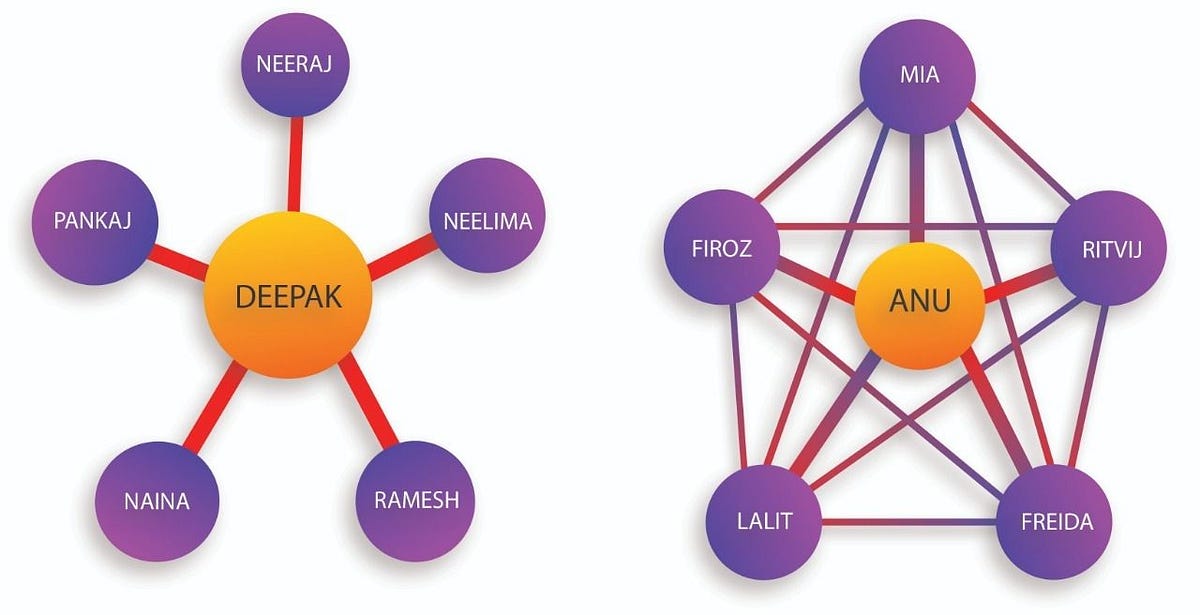
Many, including myself, commented about Deepak and Anu’s most likely strengths, attitudes, powers, difficulties, and the possible perception of their team members.
Initially I felt that difference is evident: Deepak’s team has power in the center, and team members are connected with the fiber of execution. Anu’s team reveals that power is distributed, and team members are knitted together with collaborative thread. But, as my layers of experience unfolded, I related with Anu and I started to see different ways a leader could possibly develop. Although no two journey can be generalized, but rallying on the personal space and network is essential foundation to lead inclusively, in an empowering way.
For a leader, rallying own personal space and network is essential to find their place in the system and lead inclusively, without excluding self.
What is leading anyway?
Nelson Mandela, the first black leader of his home country after many years of imprisonment known for his iconic leadership, in his fantastic autobiography, Long Walk to Freedom, parallelled a successful leader to a shepherd: “He stays behind the flock, letting the most nimble go out ahead, and the others follow, not realizing that all along they are being directed from behind.”
A great leader, like a Shepherd, stays behind the flock, letting the most nimble go out ahead, and the others follow, not realising that all along they are being directed from behind.
Also, the archetype “Leading from behind” got a cultural bump in 2011, when New Yorker’s Ryan Lizza wrote that an Obama administration official had described the president’s foreign policy as “leading from behind”.
The truth, however, is that leading from behind emanate from the universal law of inclusion: human beings are a systemic part of creation, a creative arrangement, and have their defined place.
Would this mean that the absence of a traditional top-down management hierarchy and viewing everyone as equal makes a leader inclusive?
Not really! It is a misconception that the absence of hierarchy plus assertiveness and appreciation of leader makes the group “collective genius”. Interestingly, this misconception has fashioned leaders to operate at the surface level and limit including everyone.
Leading inclusively-
Leading inclusively is about the psychological contract, formed gradually, between the leader and the team.
Tiny invisible acts of ignorance, ego, and exclusion or little welcoming gestures of care, acceptance, and inclusion adds to the psychological contract, and create the culture – culture of appreciating or being appreciative; culture of canceling people or listening to different perspectives; culture of catapulting broken to pieces or matching them as part of the whole.
A couple of years ago, I led a critical business transformation for a healthcare consumer portal, the highest revenue-generating system to organization, and presented the best annual insurance enrollment season in the last ten years. My team and I were awarded as best team, but another leader got the promotion . I was a bag full of the emotional mess for many weeks, thinking how I never sensed it passed over. It was disempowering.
Leadership cannot just go along to get along. Leadership must meet the moral challenge of the day. ~Jesse Jackson.
After collecting myself when I had a conversation with the department head, I remember the response word by word — “Ah! were you leading this transformation? You were calm in every situation as if nothing mattered. I thought you are an executor, not a leader.” It was an earthing moment for me.
Where did I go wrong in delivering without losing control ?
In hindsight, I see it as defining moment when I learned the value of personal space and psychological contract with oneself before others.
Everyone shall know that there are predators, and without knowing that, no creature will ever be able to negotiate safely in their forest. Predators could be in the form of other humans or in the form of own beliefs.
Knowing and protecting own space is empowering. It abolish the darkness of ignorance, brings own beliefs, assumptions, experiences in light; and set the social, physical, emotional boundaries;
In my proud space, I misinterpreted the meaning that everyone in the organization has a comparable skill or will at a given time. With my developing capacity to discern between intent and impact, I probably started pushing the team members to turn activists or exhausting them to run out of creative fuel.
While I was honoring my psychological contract, but I was burned out working on expanding my skills.
While I was honouring my psychological contract, but I was burned out working on expanding my skills to find place in other’s space.
“You are the average of the five people you spend the most time with.— Jim Rohn.” This is a quote made by Jim Rohn, motivational speaker, and self-help guru. I don’t fully agree with this statement as it doesn’t consider that we have our own consciousness, but I don’t negate the impact of networks on us.
This is where I looked into my personal networks. I was surrounded by leaders leading from the front, and I was comparing myself with them.
I felt empowered and invisible at the same time.
2) find the place in the system. Slay your ego.
You don’t lead by pointing and telling people someplace to go. You lead by going to that place and making a case. ~ Ken Kesey
Each member has their place in the system, and their place is based on their intrinsic capabilities and aptitude.
Collective place finds its balance on individual why and collective how.
To harness people’s collective genius, holding the space to bring out an individual’s spontaneous quality to take root and bloom is essential. It helps each team member to know their place and step in as needed.
Lay the foundation with care and presence
- Being present to own space and care for others’ space is the first step to help individuals find their place.
- Secondly, the leader encourages team members to generate, share and refine their ideas to innovate.
- Ultimately, they will integrate the ideas into the company’s framework.
Organisation change starts from Individual leader being mindful to their space, to a team where each member has a place, to an innovative and inclusive organisation.
Different individuals will come to the fore in different situations. Some individuals are typically silent, soft-spoken, or generally uneager to speak up. Harvard Business professor Linda Hill encourages companies and groups not to overlook these people.
There are invisible people in our organisations labelled, probably labelled as Executor.
3) bring invisible to the surface. Connect.
As the HBR study speaks, for one reason or another, many talented people in all parts of the world haven’t been seen as leaders.
Some are demographically invisible because of their gender, ethnicity, nationality, or even age; these are people who don’t have access to the tools — the social networks, the fast-track training courses, the stretch assignments — that can prepare them for positions of authority and influence.
Second, and more subtle, are the stylistic invisible. These are people who just don’t fit our conventional image of a leader. Because they don’t exhibit the take-charge, direction-setting behavior, which is believed to be fixed leadership traits, and get labeled as executioners.
Personal networks and social networks analysis challenges finding those invisible — people, personal traits like ego, personal space like access over the opportunity — to the surface. It not only helps the organization harness the collective genius but also brings in multifariousness and diversity.
Takeaways
It’s crucial to understand that “leading from behind” isn’t a style reserved for the uninspiring, the indecisive, or the invisible. Many people who lead from behind are perfectly capable of leading from the front.
Also, leading from behind doesn’t mean canceling your leadership responsibilities. It is not equivalent to a leader bowing out of their leadership position and instituting mob rule.
Elevating the collective over authority is the only way to go. Abscence of supporting social networks could make it lonely pursuit.
All team members — not just the most assertive ones — need to attain their place to develop ideas that will help a company or organization innovate, evolve, and flourish well into the future.
In the current working scenario, when individual mental models and social structures are shifting swiftly.
Understanding social networks has become even more necessary for leaders to operate from empowering spaces, help the team find the place, and harness collective genius.