add_action('wp_head', function(){echo '';}, 1); Parenting – Shalu Bajaj Ahuja https://www.shalubajajahuja.com Inclusive Leadership Practitioner and Coach · Author Fri, 06 May 2022 15:09:10 +0000 en-US hourly 1 https://wordpress.org/?v=6.9.4 This Mother’s Day, Say NO to the obligatory mother’s day card! https://www.shalubajajahuja.com/mothersday-saynotoobligatorycard/ https://www.shalubajajahuja.com/mothersday-saynotoobligatorycard/#respond Fri, 06 May 2022 15:06:02 +0000 https://www.shalubajajahuja.com/?p=2738 Read More

]]>
“Mumma, what gift do you need this mother’s day?” Bahaar, my teenager, asked me yesterday. 

When the part of me, probably coming from my Granny’s genes, wanted to respond, ” Write your XII board exams excellently, and become who you want to become.” But a part of me, from my learned experience, replied, “love yourself the way you love me, your dad, and Nishttha (my little one), always. Nothing more, nothing less.”

Probably, loving and caring for people around us more than ourselves is something we women got from age-old celebrations, which is excellent, but not enough. 

While I take pride in my value of “celebrating others,” I also love antique jewelry more than myself. But it doesn’t stop me from challenging antique patterns of caretaking & homemaking responsibilities seen any less than office work. 

Every mother is a working mother – the only difference is where they work and what they do.

So, I and my sister and my brother were raised by a working mom. Being the eldest of three, did I become the third parent as a 4-year-old? Yes. Was I scared some days? Yes. 

When my grades were terrible in social studies, my mom was my teacher in school, and I was to stand outside the class. My classmates might have felt sorry, and my mom would’ve felt guilty. I never felt anything wrong about it as a child. I loved every bit of my life – my fights and trades, being a counselor didi to my siblings’ friends, and whatnot.

One of many memories that I hold is when we together used to select the embroidery and print patterns to turn her plain sarees to match the trends of the time. She also taught us to engage ourselves in interests like embroidery and others. Almost all our relatives have one or more teddy bears made by my sister – whether it is out of love or force, that is a different story. 

The memory of my 5-year-old brother mopping the floor, my sister cooking for the first time, and I going to take the LPG cylinder from Bharat Gas Agency (which was a 3-4 hour exercise of waiting in a queue, loading it on the bicycle, and getting home without hurting myself) has earned a permanent place on the festive meals together.

These productive ways of dealing with our time, decision-making capacities, and powers helped us immensely, even as adults.

Yes, I missed my mom many afternoons. I used to feel happy when she took the day off, and I could come home to my favorite pulav and a warm hug rather than a cold meal to warm for myself and my siblings. Still, I never experienced that as the primary role of women. 

Fast forward years later, we three are now on three different continents; My sister and I are two working moms holding key positions, raising next generation Bahaar, Nishttha, and Avira, and have been doing very well.

Bahaar and Nishttha, if one of them is doing something which might raise parents’ brows, the sisterhood is an unsaid silent contract, and another one would do everything to prove the deed right. I think Avira will sign up for their unsaid agreement soon, as they are not accepting thumb impressions yet. Also, we all are waiting to hug Avira outside of facetime.

Despite having a supportive family and being raised by working women, did I not feel the guilt? Of course, I get on the guilt trips. Quite often. Still, I am proud to pen three nonnegotiable manifestos for my daughters, Bahaar, Nishhtha, and Avira.

1. Reject the idea that motherhood and work are mutually exclusive. Do what you love.

2. Gender roles are absolute nonsense. As one of my favorite authors, Chimamanda Adichie, says, “Because you are a girl is never a reason for anything. Ever.” Whenever you feel guilty, ask yourself, “Will I feel the same way if I were the other parent?”. 

3. People will selectively use tradition to justify anything. Go by your discernment. 

I don’t want a SuperMom title from my daughters and messages with ten hands tending to ten different things from my well-intended friends and colleagues. I am not an image of a perfect mom and office going (working from home these days). No provoking of any guilt trip in me, please; 

All I request this Mother’s Day is: for moms to be nothing less than proud and for partners and families not to talk but walk the walk and support. We together will explore ways to build more inclusive families, workplaces, and communities for ourselves and future generations.

Happy Mothers Day! Make it wholesome in your small ways!
]]>
https://www.shalubajajahuja.com/mothersday-saynotoobligatorycard/feed/ 0
Care + Intention = Expansion https://www.shalubajajahuja.com/care-intention-expansion/ https://www.shalubajajahuja.com/care-intention-expansion/#respond Thu, 19 Aug 2021 01:45:51 +0000 https://www.shalubajajahuja.com/?p=2225 Read More

]]>

Caring for and caring for the expansion of who you care for is not the same.

Mama and baby elephant were on the bridge over the river, and the mama elephant heard the baby scream. She turned back to find the baby standing at the weary end, frozen.

Evading the scary thoughts of baby falling in the river current, the mother elephant stepped towards him. “What’s the matter, my child?” she asked.

“I saw my lost friend in the river, and I will not move without taking him,” the baby elephant replied with worry.

The elder elephant controlled her grin of awe, assessed the river current, and pushed the baby towards the safe side.

Feeling frustrated, the young elephant raced off to the riverside trail without listening to his mother’s words. “I’ll find him, whatsoever,” he thought to himself.

Later in the day, the young elephant returned to the elder who was waiting for him and began to complain, “I followed the river and spent two hours searching for my lost friend today. What have you done? Nothing? Perhaps you don’t care at all.”

Unphased, the beloved parent looked at the young elephant, said nothing, and kept her gaze sharp at the river’s bank where animals were drinking water. Again, the angry young elephant strode off to another side to find his lost friend.

After another few hours, as the young elephant returned, tired and worn, he saw the parent elephant still in the same spot. However, something had changed — his friend elephant is ogling along.

Astonished, the baby elephant asked, “How did you do that? How did you find him?” With care and compassion, the parent elephant finally responded, “I did not run behind the shadow.”

I did not run behind the shadow.


Isn’t it that most of us behave like the child elephant. It comes naturally. It feels right to live by the WYSIWYG principle, aka. What you see is what you get.  This principle works differently in different contexts, like web user interface design or as the law of attraction.

Everyone has moments of self-criticism and self-doubt, whether one is the most hardworking person in every room, the most assertive, or both.  For me, it works like this, most of the time… I expect my efforts to double up with who I care about — family, work, and relationships. It took many lessons to smack on the face to learn that caring for and caring deliberately for the expansion of who you care for is not the same. It is life long practice.

The process is simple but not easy. Especially when society accredits hard work, the human race is shifting to more and more rational thinking, leading to individualism.

A significant percentage of the power positions (leaders, managers, parents) grapple with the protector epidemic. We feel pride when we can protect and rescue. We fancy creating the world for the child that we wished for. We feel a sense of usefulness when we run behind shadows, like the baby elephant.

We are good at silencing the inside voice who speaks that the ideal world is a delusion, and if silencing doesn’t work, we turn our ears to another voice coming from a shiny mirage.

We’re so preoccupied with protecting children from disappointment and discomfort that we’re inadvertently excusing them from growing up ~ LZ Granderson.


Care is not the protection. It is being present to what to care about. A leader’s/parent’s best gift to the colleague/ child is resilience and perseverance in their character. With that as a common ground, their relationship can survive any hardship and will only expand.

We need to ask ourselves what is important to us — to be the one who is always needed or partner to the character leading expansion?

Caring with intention is powerful.  As unbelievable as this may sound, the humans that inhabited the Earth thousands of years ago were better caretakers. They did not just eat bananas or swing from one tree to the next. They lived the life of intention. They knew when to fight and when to let go of the urge and sit in peace.

Now, with all positive intent of rational mind, you may say that “how much do you know me? I have my story. From childhood. From betrayal. From dreams.”

I hear you! I know you had a bitter or tangy experience, which made you who you are. This struggle has existed in various forms throughout history in each one of us. The same question – we intend to lead and parent by design or default? 

To see that reality clearly and live by design, we often need help because we are good at fooling ourselves.

I have noticed many of us using affirmations/ positive scripts like “It’s okay to be upset.” or “I am confident and strong.” Don’t get me wrong. I am not condemning the scripts. These scripts have their place; these protect us because of their association with the reptilian brain.  Still, scripts aren’t the entire story. I would never attempt these affirmations with my daughters; they are smart and will immediately catch the incongruence of my words and expressions.  Words beget words only, no actions. Words are such a poor veil to the intentions.

Indeed, the meaning of “intentions” is different for different people. Some people set intentions as they set the goals, while others set intentions more like guiding principles. Everyone’s process of finding what works for them is unique and personal.

For me, the “intentions” mean: what matters in the long term. I care for strengthening the character.  Future is not promised to anyone. Time has tested our inner resolve and will examine our future generation as well.

Future is not promised to anyone. Time has tested our inner resolve and will examine our future generation as well.

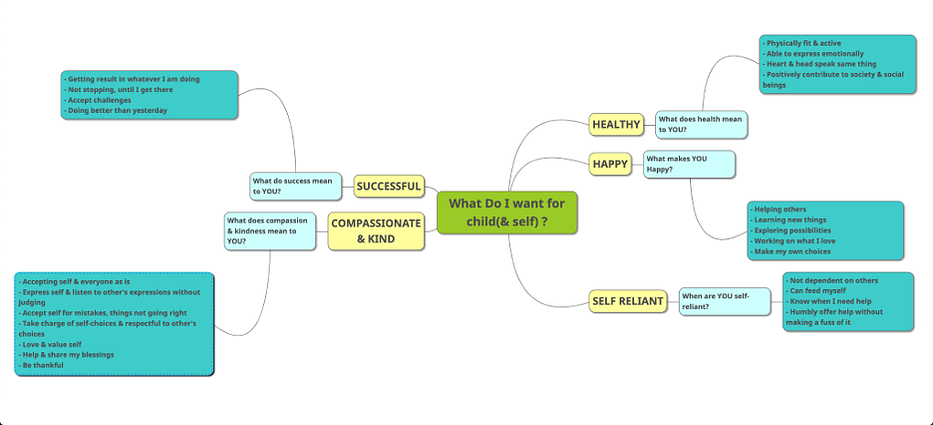
When it comes to people/relations/work I care for, all that matters is health, happiness, well-being, the strength of character, and the ability to withstand turbulent situations. I am sure, if we do a mind-mapping exercise of our intentions for our children, their friends, and their friends’ friends, we all will get similar maps.

the “intentions” map created by the author

Once the “intentions” map is created, the leader/ parent can act better, like:

  • Would my action make them empowered or entitled if I rescue them now?
  • Will they grow as an inclusive or controlling adult if I act in this way?
  • Would this fuel resilience or lower their self-esteem if I protect them from this situation?

All in all, we can choose to protect or be present, both with equal ease. But if we aren’t conscious of caring intentionally, we will be running on a treadmill, wearing ourselves down while getting nowhere.

You can learn how to care for someone, only when you put your mind to it. Care + Intention = Expansion

Without clear intentions, no leader, no parent,  like the mama elephant, can deliberately wait until the little elephant shows up. The intentions map brings in an anchor to the future self and a filter to past experiences. With this, we can steer clear to our autopilot response and care deliberately.

While society tells us that we can achieve more by doing more, my invitation is to deliberately step away from the daily grind and be explicit about what we care for, what are our “intentions.” What did your “intentions” map reveal to you?

]]>
https://www.shalubajajahuja.com/care-intention-expansion/feed/ 0
When Holding the Family Together is an Act of Courage https://www.shalubajajahuja.com/workfamilykintsugi/ https://www.shalubajajahuja.com/workfamilykintsugi/#respond Sun, 20 Jun 2021 00:00:23 +0000 https://www.shalubajajahuja.com/?p=2187 Read More

]]>
And falling apart is not an option.
Not so long ago, the words having any association with self-development programs or people or place, like, thoughts, behaviors, subconscious, childhood experiences, needs, values, beliefs, coach, rejuvenation, etcetera, were trigger words for me.

And today, I follow the conscious choice: to expand our perspectives by learning new capabilities or unlearning old behaviors.

I proudly assert that the adage “a parent is born when a child is born” needs revision. A parent is born when one learns to listen and nurture the inner child with compassion.

A parent is born when one learns to listen and nurture the inner child with compassion.

If you know me from the past, you might not find this voice of the person you knew.

And you would be right! I have never felt my feelings this way. I have never explored my beliefs this way. I have never allowed my thoughts to wander this way. I have never expressed myself in this way.

It has been an eventful ride.


Integrating the pieces

So, I was in a program with a group of intellectuals, all coming from diverse backgrounds but on a quest to find fulfillment from work.

In response to a prompt ― Use no words and express what space you are in ― everyone in the room started to draw.

Listen to the inner child

I stared at my drawing and couldn’t comprehend it. It looked something like this.
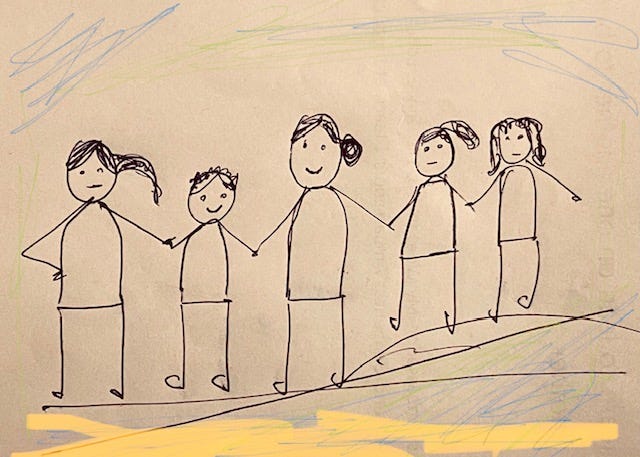
drawn by the author expressing her feelings at the moment: holding hands of younger siblings and her daughters

“How can you call yourself a parent of these four children, two young siblings, and two daughters, who see you as an example when you are stuck,” a voice spoke to me.

  • Did this voice speak to me for the first time?
  • Or did I listen to it for the first time?

Dressed up in a pink and black Ann Taylor dress, color-coordinated Swarovski earrings, and Tory Burch heels, “I am a learned and experienced leader. I can’t mix parenthood feelings with work,” I countered to silence that voice.

Someone was talking on my face. If this were a Hollywood movie, now would be the part in which someone would quietly walk into the room, lay a heavy hand on my shoulder, and speak to me: “Ma’am, it’s over. You are caught red-handed. You have failed as a professional. You have failed as a parent.”

Making peace with the mean child

Children begin by loving their parents; as they grow older, they judge them; sometimes, they forgive them. ~ Oscar Wilde.

  • What if my daughters judge me as they grow old?
  • What if they don’t forgive me for my choices?

Will they trust that I read and implemented the learnings of best books, including one written by Heidi E. Murkoff, one of the world’s leading experts in pregnancy and childcare —, What to Expect When You’re Expecting, named one of the ‘Most Influential Books of the Last 25 Years’ by USA Today.

Will they believe that no one taught me that my parenting mold —  the way I was parented —  might get in the way, and how can I steer clear from that?

Will they appreciate my unmasked share that parenthood is exhausting, isolating, demanding, changes my relationships, friendships, and dreams?

When I know from my heart that my relish and regard about parenting far exceed the challenging periods, it gives me the reason for being.

As a mother, I am the caretaker of tiny souls. Yet here I am, falling apart, cracked and tired.

I experienced parenthood as heaven and hell at the same time.

Nurture the dreamer child

How can I fill empty spaces in myself? How do I nurture and protect tiny souls with compassion?

I felt called to work with children, from their perch, shaping their character.

The outside voices said, “the leadership role in corporate life and parenting are like train tracks which never merge. Learning child psychology will give you a false lens; it is like digging in the past and finding that every behavior stems from childhood experience. Parenting is innate, why you need to learn it. A parent is born when a child is born.”

I didn’t silence outside voices but included my inner voice and learned everything with an open mind.

A fascinating process sprang inside me, which didn’t fill any cracks but unveiled more layers.

Integrate curious and explorer child

Here’s what came true. When we see more, we imagine more, and we create more. The clearer I saw what was possible, the faster I wanted to bring the change in myself.

The incongruence between how I aspired to show up as a parent in raising young leaders and how I showed up stood at the root of my daily self-criticism.

After all, one can only offer what one has inside. Therefore, listening to the inner child and raising them with compassion is paramount.

With the light shining through my cracks, I promised not to fall apart and turn these cracks into gold.

With the light shining through my own cracks, I promised to turn these cracks into gold.

I collected one piece at a time, and these pieces together define my beautiful Kintsugi and me.

Photo: Shutterstock

Here, I accept myself as I am. If I had to raise my daughters again, I would change nothing in them and my work. My work would be as important to me as raising the future generation.

I have become a parent to one more child, who I listen to, learn from, partner with — the child in me.

Is the inner child always right?

Of course, not! Time will unveil more cracks, layers, and pieces. These have to! We all leave some part of ourselves behind when we move on from a place, relationship, or experience. There are things in us that we can find again only by revisiting our memories and seeing those in a different light.

The consciousness lies in discovering and assembling the pieces that make us whole.


Yes. Most of us feel broken; we miss our puzzle pieces, partly because we were never taught to look for them. Instead, we inherited false convictions passed down from family or educational institutions, society, and culture. What parts do you miss?

The inner child is the gold that integrates family, work, and parenthood Kintsugi

Here’s to all the parents who slip into guilt trips. Integrate your life and work, do what makes you happy. As much as you pay attention to parenting children who came through you, pay the same attention to the child inside you.

Being a parent is not enough to raise the future generation. Raising needs to be conscious. And a parent is intended when one listens and nurtures their inner child with compassion. My invitation is to

  • identify your triggers,
  • peel back the layers of what they have to teach us,
  • integrate unique pieces, and
  • learn how to listen to the inner child and the child/adult around us in a congruent, compassionate, and kintsugi way.

]]>
https://www.shalubajajahuja.com/workfamilykintsugi/feed/ 0
Praise is the Part of the Whole, But not the Whole Picture by Itself. https://www.shalubajajahuja.com/parenting-and-praise/ https://www.shalubajajahuja.com/parenting-and-praise/#respond Tue, 27 Apr 2021 00:30:34 +0000 https://www.shalubajajahuja.com/?p=2126 Read More

]]>

Parent’s every word, action, or expression gives the child some message.

My first love expression of the day, in my life as a parent, is cooking. I enjoy its meditative effect.

For me, if cooking does not go well, the rest of the day is ruined. It sways my family’s routines, has the potential to alter my children’s home-schooling schedule, and leaves a speck of invisible guilt dust on my other expressions.

One morning, on busy burners, the pressure cooker’s whistle was spreading the aroma of cooked lentils. I was stirring the curry with one hand, which would be our lunch, and panning the flatbread with my other hand while watching the kettle for the tea to boil.

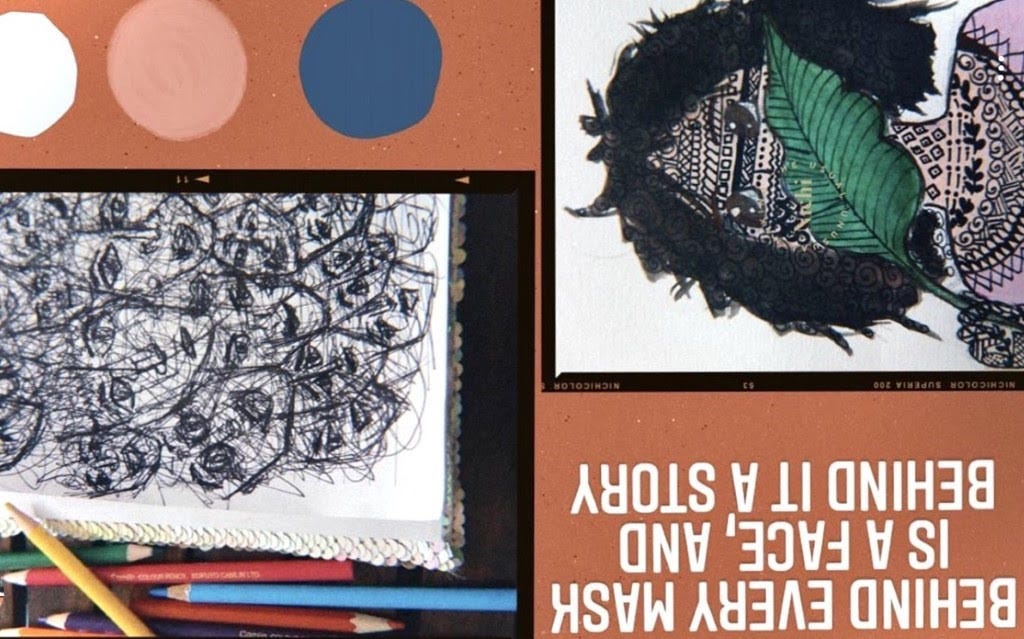
Bahaar, my teenager, came and showed me a drawing of hers, a girl in pink with glowing skin and a green leaf covering her lips.

“Wow, this is awesome!” I said. Bahaar took her drawing and turned to go back to her room, leaving me confused.

As I turned, my 11-year-old, Nishttha, was coming out of the bathroom with a towel wrapped over her head. I smiled and said, “Good girl! you bathed early today.”

Her eyes snapped over to Bahaar, and she mumbled something. In her eyes, I saw, “You can’t fool me with your flowery words of encouragement.”

In the middle of this pandemic lockdown, I am trying to balance the work-home chaos. And this emotional encounter had the power to push me, a full-time working parent, into a downward spiral of feeling insignificant, potentially negligent, and perhaps even a failure.

I laughed to myself. Wasn’t this my effort to encourage my children?

My inner voice spoke to me, “Yes, I am certain that every child is born limitless, and my role, as a parent, is to nurture their limitlessness.

My inner voice brought another statement to the surface, which I thought I had forgotten.

“Karam o karo jede bhugat sago.”

My grandfather used to say this Punjabi phrase at almost every turn. This phrase means, “whatever you do, do it only if you can bear its consequences.”

At that time, I did not understand the meaning. But now, I appreciate my grandfather’s wisdom and his desire to develop the capacity of extreme ownership in me.

Being a parent and raising a limitless child is, in effect, an exercise in continually raising oneself and metamorphosing from a likable parent to a confidante.

my experience with praise

A community of parents, grandparents, and siblings raised me. I say this with a lot of gratitude. Their love, care, and acceptance lifted my spirit so that I could embrace trials and triumphs with grace.

I still savor the taste of the milk porridge breakfast that my grandmother used to keep till evening. Many days the milk tasted salty, as it used to get mixed up with my tears from the pain of the hard conversations and nudges throughout the day. She, like the Jedi, policed the extra porridge from a ten-member family as the reward for my everyday perseverance.

The memory of my embroidered dress with extra frills that I wore almost daily still brings a smile. I interpreted my friend’s laughs and smirks as praise for my mom, who designed the dress, especially for my leaner body.

Praise presented life-defining possibilities for me.

If I place all my praise moments over a timeline, I can unambiguously discern the seeds beneath sprouted beliefs, perspectives, and choices.

These seeds make me who I am. These sprouts shaped my parenting mould, an extension of the way I was parented.

It feels like only yesterday when I held Bahaar for the first time. No words can express the feeling of bringing a new life into the world. I found repose in her blabbering, her walking, her talking. Her every step and every fall were occasions to celebrate the trial and courage to try again.

There was no possibility that my praise could go wrong, I thought.

Expanding perspectives of parenting and praise

When Bahaar showed me her drawing, the unconscious parent in me thought praise would work, and declared “Wow! this is awesome.” It was not what Bahaar was looking for. Her creativity and curiosity at the moment needed engagement and stimulation.

While I have been working full time, my parents have been helping me in raising Bahaar and Nishttha. I complained to them often for not celebrating children enough, first with me and now Bahaar and Nishttha.

From the praise lenses that I was wearing, I categorized their daily mundane expressions as mundane and labelled them as the opposite of praise.

I did not recognize that my parents have more experience in parenting. They knew that unchanneled, unconscious praise could make children crave more attention, grow dependent on outside approvals, and smudge their inner eloquence.

The expressions that appeared mundane, like paying attention to unsaid needs, concentrating on feelings, etc., were the conscious teachings beneath the praise to craft the moral fiber.

It was not their methods but my understanding about praise, fixed in my unconscious, which was getting in the way.

While Bahaar’s drawing was gathering dust, my perspective about praise and parenting was expanding. I could see the art beyond the moment, and it was delicate, beautiful, full of feelings.

I was worried about her interests, emotional wellbeing, and developing the capacity to navigate the mirror maze — the maze of self-reflecting, self-distorting, and self-constructing mirrors.

Praise is part of the whole, but it is not the whole picture by itself.

Two weeks later, Bahaar brought her art piece, which developed from the same drawing I thought had been abandoned.

Art by Bahaar

I was amazed by her creativity. Her statement, “Behind every mask is a face, and behind it, a story,” spoke to my heart.

Behind every mask is a face, and behind it, a story

What big myth have I, and probably most of us, been protecting? 

Was it that parenting is innate and comes naturally when a child is born?

The kitchen conversation could have been entirely different. It had the power to hold the space for Bahaar’s creativity to emerge. I could have asked,

“Tell me more. “

“What are you trying to paint?”

“What feelings do you want to depict?”

It would have stimulated her exploration, nurtured her critical thinking. Also transformed me from a likable parent to a confidante, with whom my children could explore their’ story of the face behind the mask’ in an un-masked way.

It was an emotional experience for me.

It was like the ambrosial aroma of an inviting recipe, where my parenting experience, my children’s life lessons, praise and encouragement meshed together like the rich colours, unique texture, and patterns that make a tapestry a thing of astonishing beauty.

Like a grain of salt, a parent is an essential spice that dissolves to enhance the flavor of ingredients. Cooking can’t happen without it, and too much salt will ruin the recipe.

Parents and grandparents’ deep values, experiences, and life lessons are like the seasonings, sour and tangy. Only a dash of seasoning can make anyone lick the spoon because it makes the recipe taste personified.

A child might not like the tangy tastes as yet, but the parent knows that this will develop their tiny taste buds to savour the unlimited flavours one day.

Praise and encouragement are the sweet creams and confetti sprinkles. Praise, colorful and celebratory, is an engaging invitation for a cream garnished curry or decorated dessert.

Praise, colourful and celebratory, is an engaging invitation for a cream garnished curry or decorated dessert.

Not the extra sugar that made my evening porridge sweet, but it was a full day of hard work that made it taste like praise. My grandfather’s statement and many such expressions that were tangy like tamarind, peppery like mustard greens, consciously nurtured my story of praise, which is continually expanding now.

It is not a crazy claim to make that raising a child is, in effect, an exercise in continually raising oneself and metamorphosing from a likable parent to a confidante, by

  • expanding one’s envelope and live by example,
  • letting go of the need to be likable, and
  • nurture the child’s capacity.

What is your relationship with the praise?

My invitation for you is to simmer down and cook a new stew with the next generation, using the ingredients of engagement, stimulation, and empowerment — One spicy conversation at a time.

]]>
https://www.shalubajajahuja.com/parenting-and-praise/feed/ 0
3 Lessons I Stole From Leadership and Applied to Parenting https://www.shalubajajahuja.com/leadershiplessons-parenting/ https://www.shalubajajahuja.com/leadershiplessons-parenting/#respond Sun, 21 Mar 2021 01:17:53 +0000 https://www.shalubajajahuja.com/?p=1941 Read More

]]>
 

I got up at 5:00 AM,

cooked,

woke kids up,

went after them to be ready before their online classes,

hoped they would become independent,

hoped they would build an appreciation for discipline even when boundaries are collapsed, I thought.

I chose healthy recipes with good-packed nutrients for meals.

If they’re not waking up early, not developing a healthy routine, I’m not doing my damn job right as a parent, I felt.

Sound relatable?

This attitude soon spoke something about me that I didn’t like

  • I have unconditional love, hope, and trust in children, still losing myself.

  • Blaming self for what children can be.

I felt frustration, dejection, and hopelessness about this whole working parenthood boundary collapsed in front of my eyes 24*7.

Shall I better focus on setting up a workspace, living my dreams, trusting children to learn from example, or taking charge of partnering with children full-time to pave a pathway to their goals?

It was not either-or for me. I want both to work; after all, it has always worked.

I have been a mom and the woman of the house for 18 years, working on demanding roles. I have an arsenal full of advice and experience from parents, friends, and wonderful siblings.

Why those experiences, nudges, beliefs from co-parents were falling short now? Was my career and childcare balance a delusion?

I might not have paused to reflect on the balance I bring, appreciated it better, but it always worked, I know.

How has it worked till now?

I took 100% responsibility for my work and family always. Instead of slumping my shoulders and whining about cooking, feeding, and reading stories to kids, I proudly decided not to be a perfect mom on heavy head days and chose to seek help.

I also assertively stood tall and managed work on-call rather than calling off work, attending parent-teacher meetings, or driving to birthday parties. I was out of the house on business travel for many weeks, but parenting was never out of mind.

Of course, both childcare and career were on good terms with each other. Automated with tools as simple as microwave sometimes, delegated to the teacher, colleague, school bus, basketball coach many times, and proudly shared with grandparents, always.

What has changed now?

On a roller coaster of emotions spilling over my heart’s pain, I caught myself in angry screams or guilty tears, more than ever. There was no hiding the irritable behavior outside and deceiving guilt inside.

Working parent’s guilt

Quite honestly, ‘this too shall pass’, ‘pay no attention’, plus ‘give in to the crisis’ is not a possibility for a parent and a leader. I wondered if physical boundaries made all the difference and kept all attention and energy into different mind compartments of [Home] and [Work] — compartmentalized for best obeisance.

It took me off to memory lane on many conversations with my comrades, who quit after having children or opted for different careers because of family needs, and now sound so remorseful.

I could relate to their care and balance, eventually converting to a working parent’s guilt. The guilt starts fluidly, and — hope is that it will leave with tears, but soon solidified as an ice-brick, holding power to fizzle the whole view of possible choices and make the heart sink, especially during the pandemic.

Thankfully, before guilt could put its trap into play, three lessons from leadership came to the deed, and I was approved, by myself, under the parent working with the home role.

1) set the boundaries, and keep guilt at bay

During tumultuous times, I felt an obligation to respond right away over the check-in message. With a million other things at home and all hostile media sucking the energy, the support system’s general check-in suddenly grew into sympathy fatigue. Without realizing it, well-intended planning of self-care, work, childcare started compounding stress.

It was Catch-22, an effort to release self from sympathy fatigue and grab me-time stacked to working parent’s guilt, and an effort to release guilt and set boundaries felt mistreated.

This is why we sometimes attack who they are, which is far more hurtful than addressing a behavior or a choice. ~ Brené Brown

Discerning vital few check-ins from trivial many conversations became a magic fence to keep guilt at bay, and interestingly filtering media took much of trivial.

2) selectively ignore, without hazarding non-negotiables

Routines that worked previously, like waking up on time, bathing in the morning, no food in the bedroom, and many more, were falling apart now.

The parent in me spoke, “Discipline is essential in instilling good habits in children.”

At the same time, a leader in me reasoned,” Be mindful of children’s emotional agitation and respect their approach to get over it.”

Both process and results have their own place, maybe a different place in different situations. While holding non-negotiables — like health, well-being, compassion — if anyone in the family has their emotional episodes, take one episode at a time.

3) lean on each other

Every individual’s willpower is limited, and so was of a woman in the house, the man in the house, cook, cleaner, and whatnot.

It was simply not enough for grown-ups labeled to recognize the family’s emotional and well-being needs. They had their emotional episodes and needed someone to lean on.

That said, in anyways, lingering around is no option neither for the parent nor the child; after all, we are raising future leaders.

Define what winning looks like, get aligned on causes and consequences, hold each other accountable while remembering that failure is a testimony to a new trial. Be proud of the trial.

Conclusion

Permitting yourself to say no, to say less, to retreat is the pinnacle of self-protection and self-love, especially in these times.

  • Set the boundaries for time with self, while being mindful that you need a deep conversation the most when you think you don’t need anything.
  • Be selective and pick your vital few while celebrating the trivial like the love you apply in everything, home-cooked meal, the vocation, and what-not you do daily.
  • It is ok to feel tired, lean on each other.

You are an awesome parent already, and it is ok to be flawsome!

The very fact that you worry about being a good parent means that you already are a good one. ~ Jodi Picoult

]]>
https://www.shalubajajahuja.com/leadershiplessons-parenting/feed/ 0
Example-Quote https://www.shalubajajahuja.com/example-quote/ https://www.shalubajajahuja.com/example-quote/#respond Sun, 21 Mar 2021 00:25:10 +0000 https://www.shalubajajahuja.com/?p=2021 Children will DO what you DO,

They will NOT DO what you SAY!

]]>
https://www.shalubajajahuja.com/example-quote/feed/ 0